
Overview of the State of Illinois Clean Water and Drinking Water State Revolving Funds (SRF)
The State of Illinois EPA (IEPA) runs the state’s Clean Water State Revolving Fund and Drinking Water State Revolving Fund programs, which provide funding wastewater, stormwater, and drinking water projects.
You may notice that IEPA doesn’t refer to the “Clean Water State Revolving Fund” and the “Drinking Water State Revolving Fund” on its website. Instead, IEPA refers to its SRF programs using the following terms:
Water Pollution Control Loan Program (WPCLP): Wastewater and Stormwater Projects
Public Water Supply Loan Program (PWSLP): Drinking Water Projects
What types of funding are available?
The WPCLP and PWSLP provide low-interest loans. Communities pay loans back over time – typically 20 years – after project construction is complete. Please review the IEPA State Revolving Fund Homepage for current loan rates.
Certain projects are eligible for reduced interest rates or “principal forgiveness” (effectively grant funding). These incentives can reduce the overall project cost for a community.
What other incentives are offered?
| Stormwater and Wastewater Projects |
|
Green Project Reserve: Principal forgiveness for projects that involve green infrastructure, water or energy efficiency, or environmental innovations. Affordability: Principal forgiveness for communities that meet certain demographic and socioeconomic criteria (population, median household income, unemployment rate, etc.). |
|
Drinking Water Projects |
|
Lead Service Line Replacement: Reduced interest rates and principal forgiveness for projects that replace lead service lines. Emerging Contaminants: Principal forgiveness for projects that address emerging contaminants in drinking water, especially perfluoroalkyl and polyfluoroalkyl substances (PFAS). Disadvantaged Communities: Principal forgiveness for communities that meet certain demographic and socioeconomic criteria (population, median household income, unemployment rate, etc.). |
Please note that some of these supplemental incentives may end within the next year(s) contingent upon funding. Reach out to Delta Institute or IEPA if you have questions about what types of funding your project might be eligible for.
Who’s eligible to apply, and what types of projects can receive funding?
Local units of government, intergovernmental agencies (e.g., sanitary and reclamation districts), and others are eligible to apply. The programs can support project planning, assessment, design, and construction.
The WPCLP funds: centralized wastewater treatment projects, sanitary sewer and combined sewer system improvement projects, sanitary green and gray stormwater projects that benefit water quality, and more.
The PWSLP funds: drinking water treatment projects, water transmission and distribution projects, lead service line replacements, water storage, and more.
Review the US EPA CWSRF and DWSRF eligibility handbooks or reach out to Delta Institute if you have questions about your project’s eligibility.
Application Process and Key Deadlines
IEPA releases new funding on an annual cycle based on Illinois’ fiscal year (FY), which runs July 1 – June 30. The application process and timeline follow this annual cycle and are the same for the WPCLP and PWSLP programs.
Considering an application? The first step is to submit a Funding Nomination Form and Project Plan to IEPA well before March 31 the year before you want to begin construction. IEPA must approve the Funding Nomination Form and IEPA by March 31 for you to be considered for funding.
A summary of the entire IEPA WPCLP and PWSLP application process is presented in the diagram below.
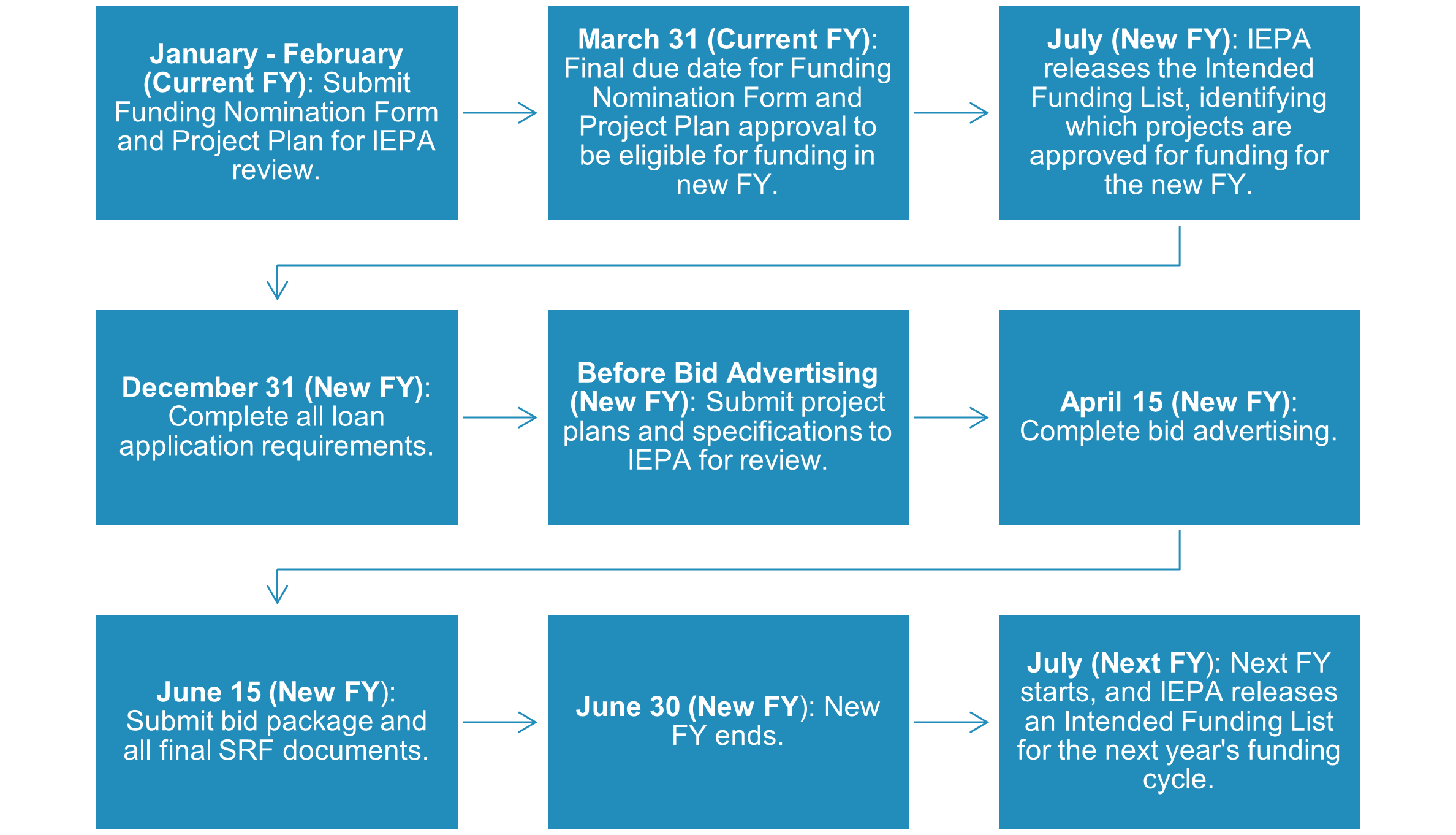
This application timeline is the same for the WPCLP and PWSLP, but IEPA uses different application documents, forms, evaluation criteria, and project ranking systems, depending on whether the project is for drinking water, wastewater, or stormwater.
Please reach out to Delta Institute if you’d like help developing an application strategy and preparing application materials for your project.
IEPA Glossary of Terms
Every State has it’s own definitions and terms for it’s loan programs; below are common terms and how the State of Illinois defines them:
Affordability – A set of criteria used by IEPA to identify economically disadvantaged municipalities that may qualify for additional subsidization. IEPA’s affordability criteria are based on population, median household income, population, unemployment rate, and service population growth rate. These criteria are defined in the IUP. Note that this definition is specific to the IEPA WPCLP for stormwater and wastewater projects.
Disadvantaged Communities – Per IEPA’s definition, a public water supply owned by a local government unit or not-for-profit water corporation that qualifies for either the Small Community Rate or Hardship Rate. IEPA offers reduced interest rates for loan applicants that qualify for these rates. Note that this definition is specific to the IEPA PWSLP for drinking water projects.
Emerging Contaminants – “Substances and microorganisms, including manufactured or naturally occurring physical, chemical, biological, radiological, or nuclear materials, which are known or anticipated in the environment, that may pose newly identified or re-emerging risks to human health, aquatic life, or the environment” per US EPA. Projects that address these contaminants may be eligible for principal forgiveness.
Funding Nomination Form – A form that applicants must submit to IEPA by March 31 to be considered for WPCLP or PWSLP funding. This form requests applicant information, a brief project description, a cost estimate for the project, an explanation of why the project is necessary, and more. IEPA has separate Funding Nomination Forms for stormwater and wastewater projects (WPCLP) and for drinking water projects (PWSLP).
Green Project Reserve (GPR) – A portion of the total funding IEPA distributes each year that is intended for projects that involve green infrastructure, water or energy efficiency, or environmental innovations. If a project meets the GPR eligibility criteria, the applicant may be eligible for principal forgiveness. Refer to these US EPA resources for additional information about the GPR.
Hardship Rate – A public water supply with a service population less than 10,000 that also meets any one of the following three criteria: the median household income of the public water supply’s service population is below 70% of the statewide average; the unemployment rate of the public water supply’s service population is at least 3.0 percentage points greater than the statewide average; or the public water supply’s annual user charge, based upon the average monthly bill of the public water supply’s residential customers, is greater than 1.5% of the median household income of the public water supply’s service population.
Intended Funding List (IFL) – A list of all applicants for a given year’s funding cycle that identifies which applicants IEPA is reserving loan funding and principal forgiveness for. For each application, the IFL provides the applicant’s name, a project description, the estimated construction start date, the projected loan amount, estimated principal forgiveness (if the applicant is approved for funding), and the number of points the applicant received. IEPA includes the IFL as an attachment to the IUP.
Intended Use Plan (IUP) – A plan released every year by IEPA, typically in July, that includes a description of the short- and long-term goals, amount of funding available, project categories, types of principal forgiveness available, the terms of financial assistance, and other information about the SRF program for that year. The IUP also lists the loan applicants for that year’s funding cycle and the amount of funding reserved for each applicant. In the Intended Funding List. IEPA releases separate IUPs for wastewater/stormwater projects (i.e., the WPCLP) and drinking water projects (i.e., the PWSLP), and posts the plans to the state’s website.
Principal Forgiveness – The portion of a loan’s principal (the amount of money requested from IEPA, not including any interest) that an applicant does not have to pay back. This portion effectively serves as a grant and is determined by IEPA depending on whether a project meets the criteria in one of IEPA’s principal forgiveness categories.
Project Plan – The project plan is a preliminary engineering report that a community must submit to IEPA to apply for a loan through the WPCLP and PWSLP programs. An applicant must receive approval from IEPA before IEPA by March 31 to be considered for that year’s funding cycle. The IEPA must be developed and stamped by a professional engineer. IEPA has separate project plan requirements for drinking water, stormwater, and wastewater projects.
Small Community Rate – A public water supply with a service population less than 25,000 that also meets any one of the following three criteria: the median household income of the public water supply’s service population is less than the statewide average; the unemployment rate of the public water supply’s service population is greater than the statewide average; or the public water supply’s annual user charge, based upon the average monthly bill of the public water supply’s residential customers, is greater than 1.0% of the median household income of the public water supply’s service population.
Who to contact for more information?
Connect with Delta Institute via email (delta@delta-institute.org) or fill out our request form on the bottom of this page (https://delta-institute.org/epa-region-5-water-infrastructure/).
Do you have questions for IEPA? You may contact their staff using the information provided on the IEPA State Revolving Fund Homepage: https://epa.illinois.gov/topics/grants-loans/state-revolving-fund.html.